
The US Army is the main branch of the Armed Forces of the United States responsible for ground military operations. It is the largest and oldest established branch in the military, and is one of seven uniformed services of the United States. The modern Army has its roots in the Continental Army which was formed on 14 June 1775, before the establishment of the United States, to meet the demands of the American Revolutionary War. The Congress of the Confederation officially created the United States Army on June 3, 1784, after the end of the war to replace the dissolved Continental Army. The Army is considered a descendant of the Continental Army and thus dates its inception from the origins of this force.
The primary mission of the United States Army is to "provide necessary forces and capabilities ... in support of the National Security and Defense Strategies." The Army is a military service within the Department of the Army, one of the three military departments of the Department of Defense. The Army is headed by the Secretary of the Army, and the highest military post in the department is the Chief of Staff of the Army. In fiscal year 2011, the Regular Army reported a strength of 546,057 soldiers, the Army National Guard (ARNG) reported 358,078, and the Army Reserve (USAR) reported 201,166, putting the total forces components combined into one 105,301 soldiers.
The US Army serves as the earthly branch of the United States Armed Forces. The Code §3062 sets the goal of the Army as:
Preserve peace and security, and provide for the defense of the United States, the Commonwealths and possessions, and any area occupied by the United States
Support national policies
Implementation of national goals
Overcome any nation responsible for aggressive acts, which endanger the peace and security of the United States

History
The Continental Army was formally established on 14 June 1775 by decree of the Continental Congress as an initiative to unify the forces of the Thirteen Colonies to fight together against the Kingdom of Great Britain. The general command was given to George Washington. Most officers were trained by the British army or carrying experience fighting the colonial militias. The war for independence had precious help coming from France, in the form of resources, troops, training and tactics. Many immigrants from Europe came to fight alongside American rebels, as Friedrich Wilhelm von Steuben, who taught the army of the new nation some Prussian war tactics.
At the beginning of the conflict (between 1776 and 1779) the Continental Army tried to catch traditional fighting against the British and suffered heavy casualties (as the humiliating defeat in the Battle of Camden). However, in some decisive battles, as in Saratoga, Americans have been successful. The war in the south, between 1780 and 1781, unfolded in an uneven struggle and guerrilla tactics, attacking an enemy force better prepared fast, small and efficient way to wear the British troops. Washington led his army to several victories in the battles of Trenton and Princeton, but was forced to retreat across the setbacks that led the British to occupy the cities of New York and Philadelphia (in 1776 and 1777, respectively). New tactics and better preparation (counting providential help from France), the Americans managed to defeat the British in the decisive siege of Yorktown. In 1781 the conflict began to tilt to the American side and finally two years later, the British accepted defeat and recognized the independence of the United States.
After the war, veterans of the Continental Army were dismissed and many received land. This policy was seen as the distrust of American Republicans with regular armies. The state militia, under the command of each state government councils, became the official army of the country, with the exception of the 1st Infantry Regiment and a battery of artillery guarding West Point's arsenal. However, tensions and continuous conflicts with Native Americans, made it necessary to create a permanent Regular Army. They received the official name of "United States Army" ("US Army") in 1796.
Organization
The US Army is divided into three components: regular, the National Guard and Reserve. These latter are formed by military half period, which are presented for training once a month, totaling at least three weeks of training per year. Both the regular and the reserve are organized under Title 10 of the US Code, while the National Guard is under Title 32. The Army National Guard is organized, trained and equipped as a component of the Regular Army, when not in service the state commands and governors. The National Guard of the District of Columbia, however, reports directly to the President. When necessary, the President has the authority to federalize the National Guard throughout the country, despite the objection of governors.
The army has a general civil leader, the Secretary of the Army, which has the statutory authority to conduct business related to the army under the command, direction and control of the Secretary of Defense. [24] The Chief of Staff of the Army, which is the highest-ranking military in the field, serves as the principal adviser and Secretary of the Executive Agent. These in turn respond to the command of Joint Staff of the United States, a body with representatives of the four branches of the armed forces that comprise the Department of Defense who advise the president (the commander in chief). They meet as the Council for National Security to conduct military affairs.
In 1986, Goldwater-Nichols Act entered into the control of the branches of the armed forces follow the chain of command from the President to Secretary of Defense directly to the Unified Combat Command, which has command of all military units. Thus, the Secretaries of the military departments (and their heads) only has the responsibility to organize, train and equip his men.

By 2013, the army has six geographic command have six unified commands (COCOM):
The Central Command, with its HQ in South Carolina;
The Army of the North, with its HQ in Texas;
The Army South, with its HQ in Texas;
The Army Europe, with its headquarters in Wiesbaden, Germany;
The Army Pacific, with its headquarters in Hawaii;
The Army of Africa, with its headquarters in Vicenza, Italy;
The army is also changing its structure divisions to brigades. The command of the divisions would be continued to command those brigades with the same command structure. The goal is to unify the brigades in its function. The three types of combat brigades are:
Armored brigades, with force of 4743 troops and the equivalent of mechanized infantry or tank brigade;
Stryker brigades, with the force of 4500 soldiers and based on Stryker combat vehicles;
Infantry brigades, with strength of 4413 soldiers and the equivalent of a light infantry brigade or parachute;
In addition, there are brigades of combat support and service. The brigades of support include a military aviation (Combat Aviation Brigade), which has light and heavy units, artillery brigades (transformed into divisions) and surveillance battalions. Brigades of Service and Support comes in many shapes and sizes to support the army's combat units.
Regular combat maneuvers organizations
The regular army today comprises 10 active divisions, as well as several independent units. After years of increasing effective at the beginning of the century, a program to reduce the size of the troop came into force. In June 2013, the army announced a reduction of 32 brigades of active combat in 2015 to bring the number of troops on active duty for 490 000. The then head of the General Staff of the army, Gen. Raymond Odierno, projected that by 2018 the army would only "450,000 active soldiers, 335 000 in the National Guard and 195,000 in reserve."
Within the National Guard and the Army Reserve there are eight active divisions, fifteen brigades maneuver, as well as support forces and combat units of cavalry, infantry, artillery, military aviation, engineers and support battalions.

The following list shows the patents and insignia of the US Army and its NATO equivalent designation. There is no live officer with the rank of "General of the Army" (five stars), and this patent is only granted by Congress in wartime.
Currently the Army has 546,047 soldiers on active duty, 557,246 more in reserve or National Guard, totaling 1,105,301 combatants.
Training
he army training is divided into two phases - individual and collective. Basic training consists of 10 weeks for most recruits followed by Advanced Individualized Training (AIT, or "Advanced Individualized Training") when they receive training to become specialists (MOS). Training of these lasts for 14 to 20 weeks by combining the basic and specific training. The course of AIT varies for each office specialist. Some positions require months of training (such as foreign language translators). Depending on the needs of the army, the basic combat training for soldiers is conducted in various locations around the country, but the most long workouts, such as the School of Armoured and Infantry School at Fort Benning happen, Georgia.
After basic training and / or advanced individually, soldiers can choose to more training and apply the "additional skill identifier" (ASI, or "additional skill identifier"). The ASI allows the army to increase the dynamics of experts and improve the skills of these. For example, fighting the doctor, whose duty is to provide pre-hospital care and treatment, can receive an ASI training to become a cardiovascular specialist, an expert dialysis or a licensed Nurse. For commissioned officers, the ASI training includes pre-commissioning training at West Point, or the Officers Training School Reserve or at closure of the School of Official Candidates. After receiving his commission as an officer, they received specialized training to their areas in the Basic Officer Leaders Course ("Basic Course Leaders Officials), which varies in length and local time depending on where the official will be sent. Future enhancements career are available in Army Correspondence Course Program, a kind of distance learning.
The collective training is offered for the units in their certain seasons, but the hard training offered is conducted in three combat training centers: the National Training Center (NTC or "National Training Center") at Fort Irwin, California ; the Joint Readiness Training Center (JRTC, or "Training Center Prep Set") at Fort Polk, in Louisiana; and the Joint Multinational Training Center (JMRC or "Multinational Training Center Set") headquartered in the city of Hohenfels, Germany. The new training program (the ARFORGEN, which focuses mainly on counter-terrorism) is a project launched in 2006 to better qualify the American forces at any level units, to adapt to new missions. Improvement at the individual level still requires training for units, which is done at Fort Bliss in New Mexico, and Texas.
weapons
For individual use
The army has several small arms and light weapons for their soldiers. The most common weapons are the M16 assault rifles, M4, and the FN SCAR. The default secondary weapon is the M9 pistol (some also rely on the M11).
Several soldiers also receive several varieties of different weapons, like machine gun M249 SAW (Squad Automatic Weapon), to provide greater firepower. Some also feature the M203 grenade launcher 40 mm. The shotgun is the standard M1014 or the Mossberg 590 that are used to combat short or to bring down doors. The M14EBR is used by support shooters, along with the snipers who use the M107 and M82 rifles, the M2010 and M110 semi-automatic rifle. Hand grenades used are the M67 fragmentation and M18 smoke.
Support weapons
A US military practicing with his M2 machine gun.
Several heavy support weapons are used by the infantry to give superior firepower, beyond individual weapons.
The M240 machine gun is the standard gun of the armed forces. The Browning M2 is usually the standard machine gun mounted on vehicles. In the same way the grenade launcher 19 Mk is also widely used in mechanized units.
The army uses primarily three types of mortar to support and complement the artillery. The lower the 60mm M224 mortar, standard for infantry units. For greater firepower for the M252 81 mm and the M120 / M121 120 mm, used by mechanized forces.
Fire Power to support the infantry units is made by a variety of howitzers guns, including the M119A1 105 mm and M777 155 mm (which is replacing M198).
The army also uses rocket launchers and missiles to give an even greater firepower to its military, especially to combat enemy armor. The AT4 is the main anti-vehicle weapon and anti infantry bunker, with a range of up to 500 meters. The FIM-92 Stinger anti-aircraft is the standard Army gun. The launches FGM-148 Javelin rockets and BGM-71 TOW are the main anti-tank weapons.

vehicles
The main utility vehicle infantry is the High Mobility Multipurpose Wheeled Vehicle (HMMWV), known as the Humvee. He is able to carry troops, cargo, weapons platform and also serves as ambulance, plus some other roles. Among the several used variants, vehicles and multipurpose trucks are the most common of HEMTT family. But the M1A2 Abrams main battle tank is shielded standard Army Combat, while the M2A3 Bradley is the main infantry fighting vehicle. Another armored troop carrier widely used is the Stryker and the M-113.
American soldiers on patrol in Iraq in March 2008, supported by a Humvee vehicle.
There are also several varieties of vehicles resistant to mines and explosive (or MRAP). The Pentagon planned to buy more than 25,000 armored MRAP type since 2007 in 25 different variants. The army plans to divest of 7456 vehicles and maintain 8,585 others. Of the armed forces plan to hold, 5036 will be stocked in the reserve, 1073 will be uados for training and the rest will be distributed among active troops. About 5681 M-ATV Oshkosh vehicles will be maintained. Others who should also be active, but to a lesser volume is the Navistar MaxxPro Dash (2633 standard units plus 301 Maxxpro ambulance version). Other various types of armor, as the Cougar and BAE Caiman also have enough divested units.
The US military has the self-propelled howitzer M109A6 Paladin to give more artillery firepower. The M270 MLRS rocket launcher also provides heavy support.
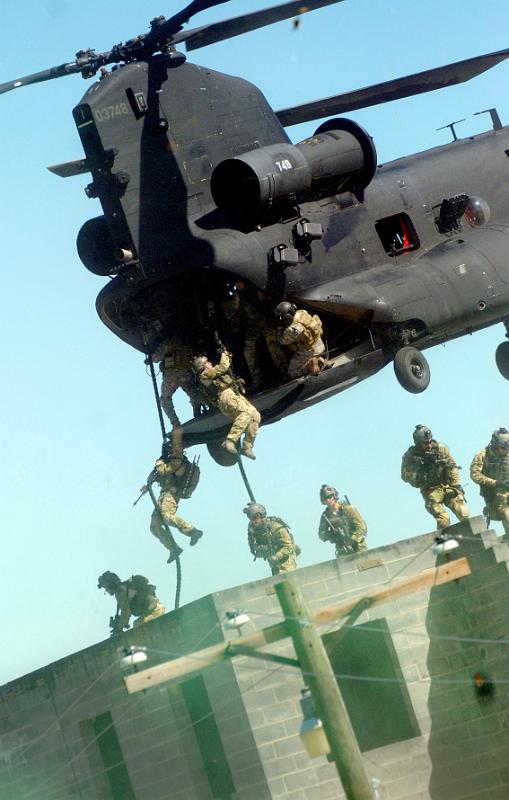
The army operates several aircraft, including airplanes and helicopters. The AH-64 Apache is the primary attack helicopter, the OH-58D Kiowa Warrior is the leading helicopter reconnaissance and light attack, the UH-60 Black Hawk is the leading helicopter multi-function utility and the CH-47 Chinook is the Heavy conveyor padrão.Os Army restructuring plan foresees a reduction of the current number of aircraft in active service (currently more than 750 in the inventory). The infantry also has several ships to support and transport.
Aircraft are also used by the military to combat situations that do not involve, as a carrier material. Still, the army still relies on the Air Force to carry large amounts of material.

Nenhum comentário:
Postar um comentário