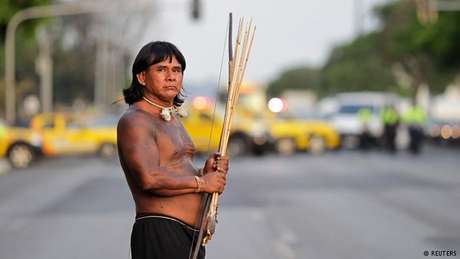
Indigenous protest in Brasilia in favor of land demarcation
Never before have so many people been murdered in the world in defense of the environment as in 2016. The ranking leader who maps this type of violence once again is from Brazil: there were 49 deaths last year, Global Witness said on Thursday, (13).
"It was not a surprise. Brazil is the most dangerous country in the world for those who fight for land rights and protection of the environment," says Billy Kyte of the British organization. Around the world, 200 killings of environmental activists have been mapped out by the organization.
"This is just the tip of the iceberg. We think the number of deaths is higher, but they do not always come to public notice, or their real causes are reported," says Kyte.
Global Witness has gathered information since 2002, and five years ago, Brazil first appeared at the top of the list. Since then, the country has never lost the position of "leadership".
Amazon: violent territory
Rondônia, Maranhão and Pará - all part of the Legal Amazon - were the most violent states in 2016. For the Pastoral Land Commission (CPT), created in 1975 and initially linked to the Catholic Church, the advance of the agricultural frontier is behind this scenario .
"The cause is in the expansion of agribusiness, construction of large infrastructure projects such as dams and hydroelectric plants, railways," says Thiago Valentin, of the CPT national secretariat. "It's a historical problem: the exploitation of outsiders on the people who live in the region," he adds.
Like Global Winess, the CPT accounts for murders of community, indigenous, landless, squatter, rural and quilombola leaders. In 2016, the agency counted even more deaths than the NGO: 61 victims.
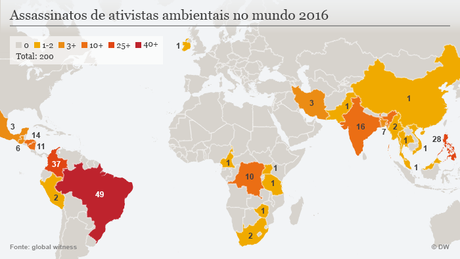
Map shows the deaths of environmentalists around the world
"These people are much more than environmental defenders, they are fighting for rights, for territory, for land, for water, and it goes far beyond the environmental issue," says Valentin.
Agribusiness Lobby
Researcher Carlos Alberto Feliciano, from the Paulista State University (Unesp), has published a series of articles on violence in the field. He estimates that since the year 2000, about 1 million families have already suffered threats from conflict. "They range from eviction, crop and house destruction, and physical threats," Feliciano said.
The trend is negative, warns the researcher. "Agribusiness needs, by 2026, according to data released by the sector itself, of 15 million hectares." To expand in this way, there will be progress on someone's land.
"The agribusiness lobby in Brazil is very strong, and now we see a government that is going backwards to protect environmental laws, which causes more deaths," Kyte criticizes.
How to stop violence
Throughout the world, the struggle for land rights and natural resources have motivated the 200 murders recorded in 2016. "The imposition of mining, hydroelectric, logging and agricultural projects on territory occupied by traditional communities, and without the consent Of them, fuel the deaths, "says Global Witness.
In Colombia, where the peace process was negotiated, last year was the deadliest in history for activists. Areas hitherto occupied by the armed movement are now in the sights of extractive companies. And communities returning to their former territories have been victims of attacks, according to the organization.
Global Witness blames governments, companies, investors and bilateral partnerships for the scenario that leads to the deaths. "They need to address the causes of increased violence, not to authorize or participate in the projects, and more: killers need to be held accountable and arrested," Kyte argues.
In Brazil, the Human Rights Defenders Protection Program, created in 2004, serves seven states in the country, but does not cover the three countries with the highest number of deaths in 2016 - Maranhão, Pará and Rondônia.

Nenhum comentário:
Postar um comentário